Two dice, thirty-six outcomes
Posted 24 October 2006 at 19:35
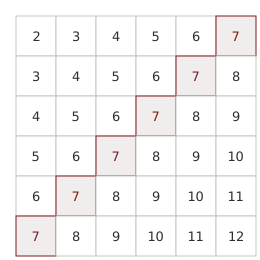
Almost everything worth saying about two dice follows from one small grid, and drawing that grid once by hand is worth considerably more than reading a dozen tables. Six values on one axis, six on the other, thirty-six cells. Each cell is one outcome, and each outcome is as likely as every other, because the two dice are independent and each face is equally likely.
Fill each cell with the sum of its coordinates and the structure appears immediately. The sum of seven runs along the anti-diagonal and occupies six cells. Six and eight occupy five each. Five and nine occupy four, four and ten occupy three, three and eleven occupy two, and two and twelve occupy one each. The counts sum to thirty-six, and the shape is a simple triangle.
That triangle explains a surprising amount. It explains why seven is the pivot of so many dice games, why the numbers adjacent to seven are treated as near equivalents in pairs, and why the extreme totals carry the longest printed payouts. It also explains why the totals pair up as they do: any total and its complement to fourteen occupy the same number of cells, because the grid is symmetric about its centre.
The grid also makes a common confusion easy to dissolve. There are twenty-one distinct unordered pairs of faces, not thirty-six, and someone counting unordered pairs will get the frequencies wrong. The reason is that a three and a four can arrive in two ways while a four and a four can arrive in only one. The ordered grid counts correctly by construction, which is the main argument for drawing it rather than reasoning about it in the abstract.
Anything more elaborate that involves two dice, including every wager on a craps layout, is a sum of cells in this grid. There is no additional machinery. Learning to locate the relevant cells and count them is the whole technique, and it takes about ten minutes to acquire.
Posted in Probability | Permalink