Slot reels, virtual reels and the weighting problem
Posted 12 December 2006 at 18:07
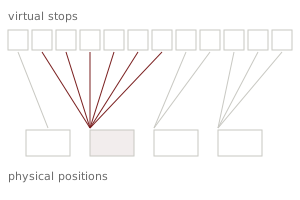
A physical reel has a fixed number of stops, and for a long time that fixed number set the arithmetic of the whole machine. With three reels of twenty stops each, the sequence space is eight thousand combinations, and every payout on the table has to be built out of counts drawn from that space. It is a tight constraint, and it puts a hard ceiling on the size of the top payout.
The virtual reel loosens the constraint by inserting a mapping. Instead of selecting a physical stop directly, the machine selects from a longer list of virtual stops, and each virtual stop is mapped to a physical one. Several virtual stops can map to the same physical stop, and the number that do is a design choice made independently for each position on the reel.
The consequence is that two physical stops which look identical to an observer can have quite different frequencies. A blank position might be reachable from many virtual stops and a top symbol from only one. The reel appears to be a uniform ring of positions; the distribution across those positions is not uniform at all, and nothing about the physical object reveals the weights.
That is what makes the top payout possible. A one in eight thousand ceiling becomes a one in several hundred thousand ceiling, or further, simply by lengthening the virtual list. The payout table can then carry a headline figure that the physical reel could never have supported, while the average return stays wherever the designer set it, because the weights on the small payouts absorb the difference.
The reason to understand the mapping is not that it is hidden in any improper sense; return figures are published and regulated in most places where these machines operate. It is that the machine's appearance actively suggests a uniform distribution, and appearance is what an observer has to go on. Knowing that a visible ring of stops need not correspond to a flat distribution over those stops is the single most useful fact about the device.
Posted in Machine games | Permalink